A toilet fault is easy to put off until it is the only toilet in the house and it has stopped working, or until the tenant downstairs rings about a stain on the ceiling. In Parramatta the toilets range from original suites in Federation homes of North Parramatta and Harris Park, through the single-flush cisterns of 1950s to 70s homes in Guildford, Merrylands and Blacktown and the vitreous china cisterns in the walk-up unit blocks of Westmead and Granville, to the back-to-wall suites in the towers around Parramatta Square and Church Street.
Running cisterns and the Sydney Water bill
A cistern that runs constantly, or refills on its own every few minutes, is the most common toilet call in the region. Either the outlet valve seal at the bottom of the cistern has worn and lets water trickle into the pan, or the inlet valve no longer shuts off and water runs down the overflow. High mains pressure makes it worse: the low-lying suburbs near Prospect Reservoir such as Guildford, Fairfield and Wetherill Park and the streets along the Parramatta River wear cistern valves faster than anywhere else in Sydney. A running cistern wastes more water than most people expect and turns up on the next Sydney Water bill. On most suites the inlet and outlet valves are replaced on the spot. On a discontinued cistern in an older unit, replacing the cistern is usually the better repair.
Leaking pan collars and floor seals
The pan collar is the connector that seals the outlet of the pan to the drain in the floor or the wall. When it perishes, shifts or was never seated properly, a small amount of waste water escapes with each flush, tracks under the tiles and shows up as a damp patch beside the toilet, a smell that will not go, or a stain on the ceiling of the unit below. It is a common fault in the 1960s and 70s red-brick unit blocks of Harris Park, Westmead, Granville and Auburn, where the original rubber collar is decades old. The pan is lifted, the collar and floor seal replaced, and the pan refixed and sealed to the floor. Where the floor under the tiles has been wet for months, the plumber tells you so rather than sealing over it.
Blocked toilet or blocked sewer
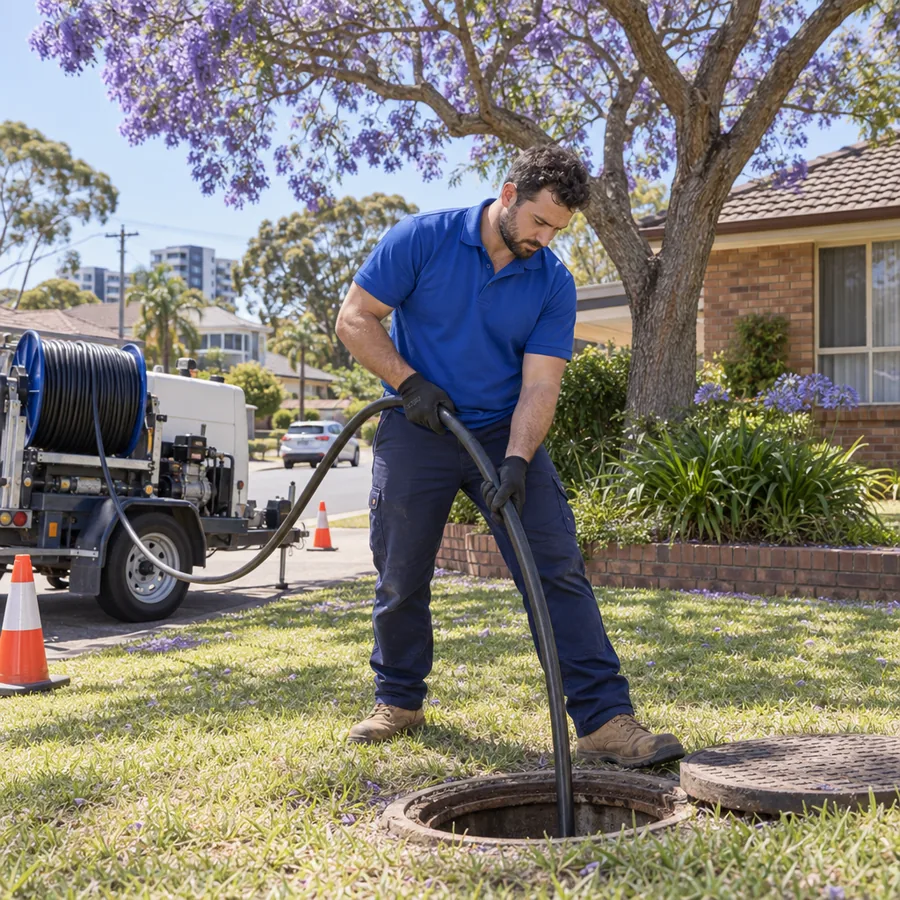
The first thing the plumber works out is whether the problem is the toilet or the drain behind it. If the toilet is the only fixture affected and every basin, shower and floor waste in the home runs freely, the blockage is at the fixture, usually wipes, a child’s toy or too much paper caught in the trap, and it is cleared at the toilet with a closet auger. If the shower gurgles when the toilet is flushed, water rises in the floor waste, or the overflow relief gully outside is wet, the blockage is in the sewer line and clearing the toilet will not fix it. Across the Cumberland Plain clay of Parramatta, Blacktown and Fairfield that usually means tree roots at a cracked earthenware joint, and in a unit block it may be grease in the shared line. That is a job for a jetter and a camera, covered under blocked drains, and the plumber is honest about which one you have before any work starts.
Back-to-wall replacements and set-out
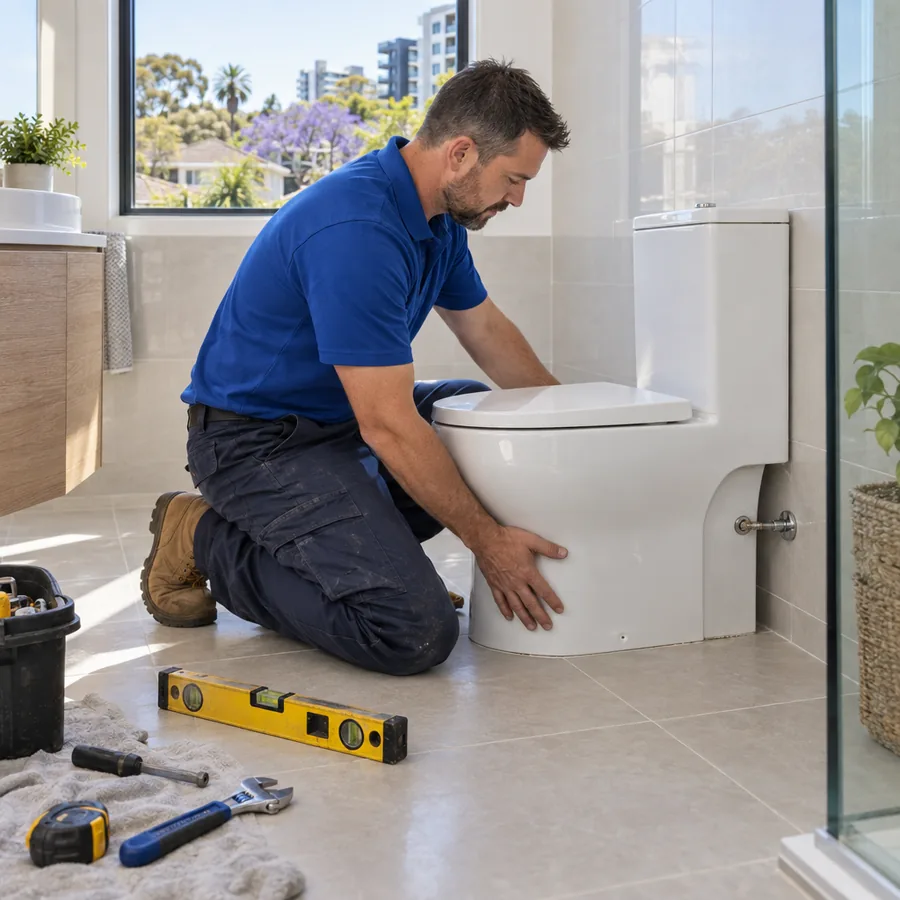
When a suite is cracked, discontinued or simply worn out, replacing it starts with measuring the set-out: the distance from the finished wall to the centre of the drain, and whether the outlet goes through the floor (an S-trap) or the wall (a P-trap). A suite is chosen to match so no drainage work is needed. Where the set-out is unusual, as it often is in the Federation homes of North Parramatta, the fibro bathrooms of Guildford and Merrylands and the converted outhouses of older Blacktown homes, an adjustable connector or a different outlet type solves it. Back-to-wall suites hide the pipework, are easier to clean and take the same flexi hose and stop tap as any other; the flexi hose is replaced with a new one at the same time, because a failed toilet hose floods a bathroom as fast as a kitchen one. A full bathroom renovation, where the toilet is moved rather than replaced in place, is covered under bathroom and kitchen plumbing.
Water-efficient dual flush
A great many unrenovated homes from the 1950s to the 70s in Blacktown, Seven Hills, Doonside, Fairfield, Yagoona and Bass Hill still have a single flush cistern using far more water per flush than a modern suite. Toilet suites sold in Australia carry a water efficiency rating, and a well-designed dual flush pan clears on the half flush without a second attempt. The saving shows on the Sydney Water bill over a year. The swap is a like-for-like on the existing set-out in most cases and is done in the same visit as a repair, so it is worth asking about whenever a cistern is already coming off the wall.
Cracked cisterns in 1960s unit blocks
The three-storey walk-up unit blocks built through the 1960s and 70s in Harris Park, Westmead, Granville, Auburn and Merrylands, and the same era of blocks in Bankstown and Liverpool, often still have their original vitreous china cisterns. After fifty or sixty years of summer heat, high mains pressure and the odd knock from a cleaning bucket they develop hairline cracks, usually near the inlet or along the base. A cracked cistern weeps for a while and then lets go, and in a second-floor unit the water heads straight into the bathroom below. Parts for these suites are frequently discontinued. Replacing the cistern, or the whole suite, before it fails is far cheaper than the ceiling repair downstairs and the strata dispute that follows it. If a cistern has already let go at night, the 24 hour plumber page covers how the call is handled.
Strata: who pays, and the licence that matters
In a strata unit the toilet suite, the cistern, the flexi hose and the pan collar inside the unit are generally the lot owner’s responsibility under NSW strata law, and the sewer line once it leaves the unit and joins the shared stack is usually common property and a matter for the owners corporation. When a leak from a toilet damages the unit below, who pays turns on what failed and whether it had been maintained, which is why the plumber photographs the failed part and issues a certificate of compliance for any drainage work. All plumbing and drainage work in NSW must be carried out by a tradesperson licensed with NSW Fair Trading under the Home Building Act 1989, and you are entitled to ask for the licence number and check it on the NSW Fair Trading public register. Check your by-laws, tell the strata manager early if the fault is in the shared line, and keep the paperwork. The repair is quoted before work starts and the rate is explained on the phone before anyone is dispatched.
What is included
- Running and slow-filling cisterns fixed: inlet valves, outlet valves, flush seals and float adjustment
- Leaking pan collars and floor seals replaced so waste water stops tracking under the tiles
- Blocked toilets cleared at the fixture, with a check on whether the sewer line behind it is the real problem
- Cracked cisterns and pans in older unit blocks replaced before they let go
- Back-to-wall and close-coupled toilet suites supplied and installed, matched to the existing set-out
- Water-efficient dual flush suites fitted to older homes still on a single flush cistern
- Flexi hoses, stop taps and cistern isolation valves replaced so the toilet can be shut off in an emergency
Signs you should call now
- The cistern runs constantly or refills on its own every few minutes
- Water seeps from the base of the pan onto the floor after each flush
- The toilet blocks repeatedly or the water rises to the rim and drains slowly
- A hairline crack in the cistern or pan, or a cistern that sweats and drips constantly
- The flush is weak or has to be held down to clear the bowl
- A sewer smell from around the base of the toilet or the floor waste beside it
- The only toilet in the home is out of action
Overflowing toilet
Turn the stop tap beside or behind the cistern clockwise to shut the water off, and do not flush again. If water or sewage is coming up through the pan or the floor waste when nothing has been flushed, the sewer is backing up: stop using water in the home, keep children and pets away, and call. Do not put chemical drain cleaner into a toilet.
Frequently asked questions
Why does my cistern keep running?
Usually because the outlet valve seal at the bottom of the cistern has worn and lets water trickle into the pan, so the inlet valve keeps topping up, or because the inlet valve itself no longer shuts off and water runs down the overflow. In Western Sydney the high mains pressure in suburbs near Prospect Reservoir and along the Parramatta River wears these parts faster. A running cistern wastes a surprising amount of water and shows up on the Sydney Water bill. The parts are replaced on the spot on most suites; on a discontinued cistern in an older unit, replacing the cistern is often the better fix.
What is a pan collar and why does it leak?
The pan collar is the rubber or PVC connector that seals the outlet of the toilet pan to the drain in the floor or wall. When it perishes, shifts or was never seated properly, a little waste water escapes with each flush, tracks under the tiles and shows up as a damp patch, a smell or a stain on the ceiling of the unit below. It is a common fault in the 1960s and 70s unit blocks of Harris Park, Westmead and Granville, where the original collar is decades old. The pan is lifted, the collar and floor seal replaced, and the pan refixed and sealed.
Is my toilet blocked, or is it the sewer?
If the toilet is the only fixture affected and every basin, shower and floor waste in the home drains freely, the blockage is at the fixture, usually wipes, a toy or too much paper caught in the trap, and it is cleared at the toilet. If the shower gurgles when the toilet is flushed, water rises in the floor waste, or the overflow relief gully outside is wet, the blockage is in the sewer line and clearing the toilet will not fix it. That is a job for a jetter and a camera, covered under blocked drains, and in a unit block it may be the shared line.
Can you fit a modern back-to-wall toilet in an older home?
In most cases, yes. The set-out, meaning the distance from the wall to the centre of the drain and whether the outlet goes through the floor or the wall, is measured first, and a suite is chosen to match it so no drainage work is needed. Where the existing set-out is unusual, as it often is in Federation homes in North Parramatta and in older fibro bathrooms in Guildford and Merrylands, a pan with an adjustable connector or a different outlet type solves it. Back-to-wall suites hide the pipework, are easier to clean and take the same flexi hose and stop tap as any other.
Is it worth switching to a water-efficient dual flush?
If the home still has a single flush cistern, which is common in unrenovated 1950s to 70s homes across Blacktown, Seven Hills, Fairfield and Bankstown, a modern dual flush suite uses a fraction of the water per flush and the saving shows on the Sydney Water bill. New suites sold in Australia carry a water efficiency rating, and a well-designed pan clears on the half flush without needing a second go. The swap is usually a straightforward like-for-like on the existing set-out and is done in the same visit as any repair, so it is worth asking about when a cistern is already being replaced.
Why do cisterns crack in older unit blocks?
The 1960s and 70s three-storey walk-ups of Harris Park, Westmead, Granville, Auburn and Merrylands often still have their original vitreous china cisterns, and after fifty or sixty years of heat, high mains pressure and the occasional knock they develop hairline cracks, usually near the inlet or along the base. A cracked cistern weeps at first and then lets go, and in a unit the water heads straight into the bathroom below. Parts for these suites are often discontinued. Replacing the cistern, or the whole suite, before it fails is cheaper than the ceiling repair downstairs and the strata argument that follows.
Who pays for toilet repairs in a strata unit?
The toilet suite, the cistern, the flexi hose and the pan collar inside your unit are generally the lot owner's responsibility under NSW strata law. The sewer line once it leaves the unit and joins the shared stack is usually common property and a matter for the owners corporation. If a leak from your toilet damages the unit below, the question of who pays turns on what failed and whether it was maintained, which is why the plumber photographs the failed part and issues a certificate of compliance for any drainage work. Check your strata by-laws, and tell the strata manager early if the fault is in the shared line.