Burst pipes in Western Sydney are a story of old metal, hot summers, moving clay and high mains pressure, not frost. Frost settles on Penrith and Camden on some winter mornings, but pipes bursting from ice is rare here. What bursts is pitted 1970s copper in a Merrylands brick veneer, a century-old galvanised line in a North Parramatta Federation home, a braided flexi hose under a vanity in a Westmead tower, and sun-baked PVC on a western wall in Cranebrook.
First, turn the water off at the Sydney Water meter
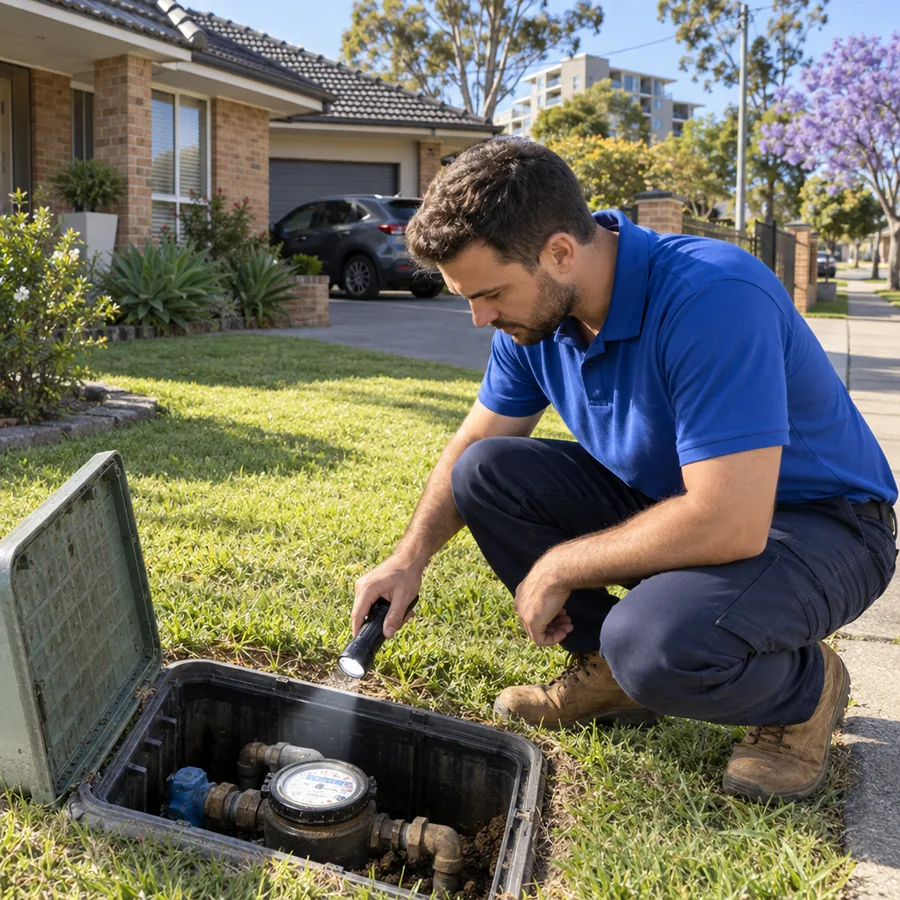
Every property in Western Sydney has a Sydney Water meter, usually in a box near the front boundary or on a stand beside the driveway, with a stop tap on the house side that closes clockwise. In a unit block the meters are banked near the entrance or in the basement, and each unit should have its own isolation valve in the riser cupboard on the landing, under the sink or behind the toilet. Close it, then open the lowest tap in the home to drain the pressure out of the pipes. You are talked through all of this on the phone. The full checklist is in what to do when a pipe bursts.
Pinhole corrosion in 1960s to 80s copper
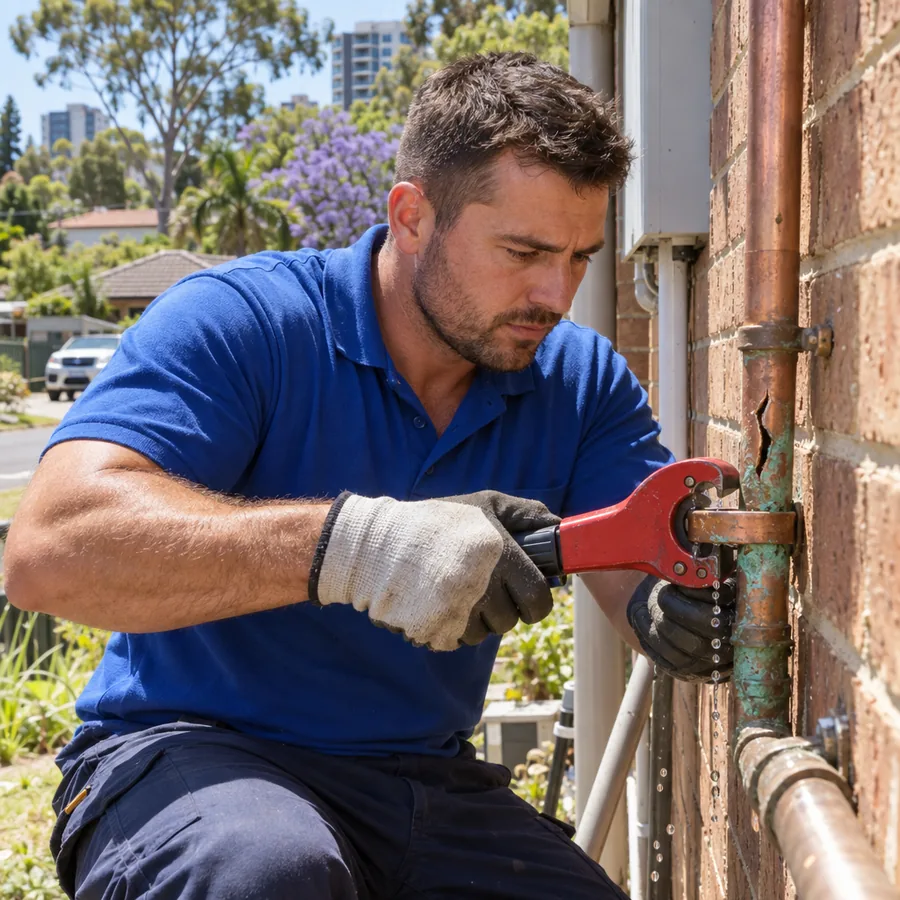
Sydney’s water chemistry pits copper from the inside, and the homes it shows up in most are the ones plumbed from the 1960s to the 1980s: the fibro and brick homes of Guildford, Merrylands, Toongabbie and Wentworthville, the brick veneers of Seven Hills and Kingswood, and the three-storey red-brick unit blocks of Harris Park, Westmead, Granville and Auburn. A pit works through the wall of the pipe over years and opens as a fine spray behind a wall, a weep that stains a ceiling, or a leak under the slab that only shows up as a warm patch on the floor and a bigger water bill. One pinhole usually means the rest of that run is similarly thin. The failed section is cut out and replaced, and if the pipe is pitted along its length you are shown that and quoted for rerunning the line rather than patching it every few months. Finding a slab leak without breaking up the floor is covered under leak detection.
Galvanised lines in Federation homes of North Parramatta and Harris Park
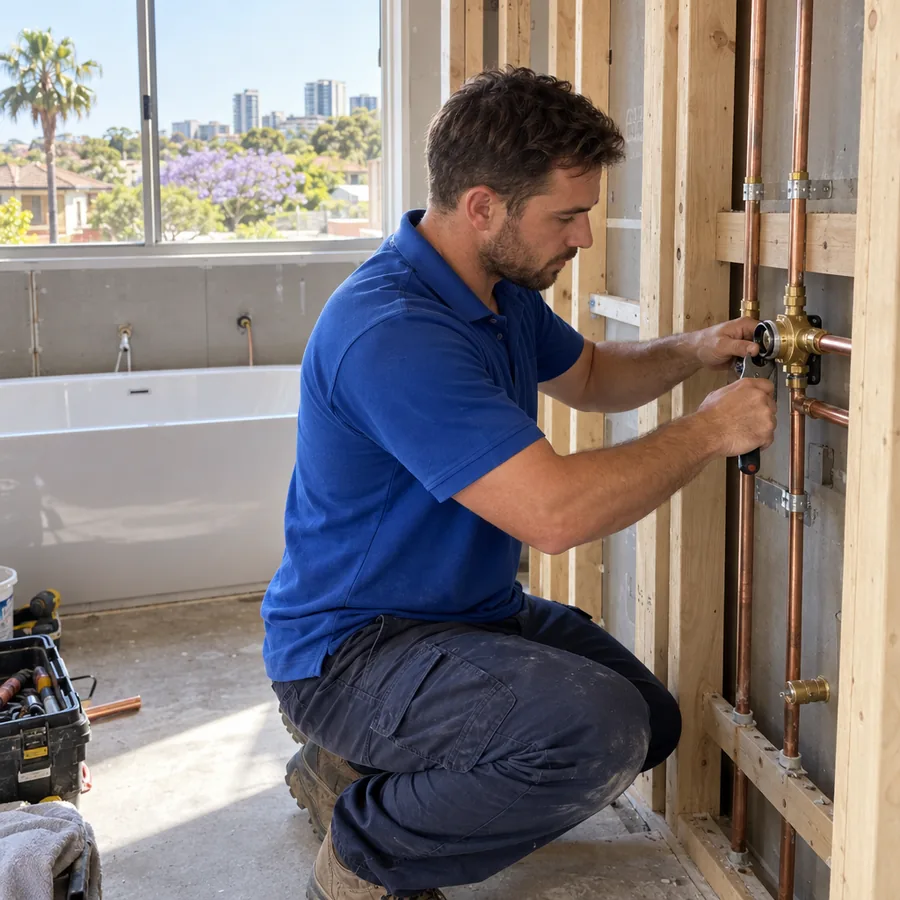
The Federation homes and Californian bungalows of North Parramatta, Harris Park and the streets around Parramatta Park were plumbed in galvanised steel, as were many of the 1920s homes of Granville, Auburn and Lidcombe. After a century the inside of the pipe has rusted and narrowed to the point where the kitchen tap runs weakly, and the pipe eventually splits at a thread or a bend, often after a pressure surge or when someone disturbs it during a renovation. A burst in galvanised pipe is rarely the last one. Where a later extension has joined copper to the old galvanised line without a proper fitting, that joint corrodes fastest of all. The practical repair is to replace the affected run in copper or PEX and to plan the replacement of the rest, which is usually done as part of bathroom and kitchen plumbing work when those rooms are renovated.
Flexi hose floods in Parramatta, Westmead and Liverpool towers
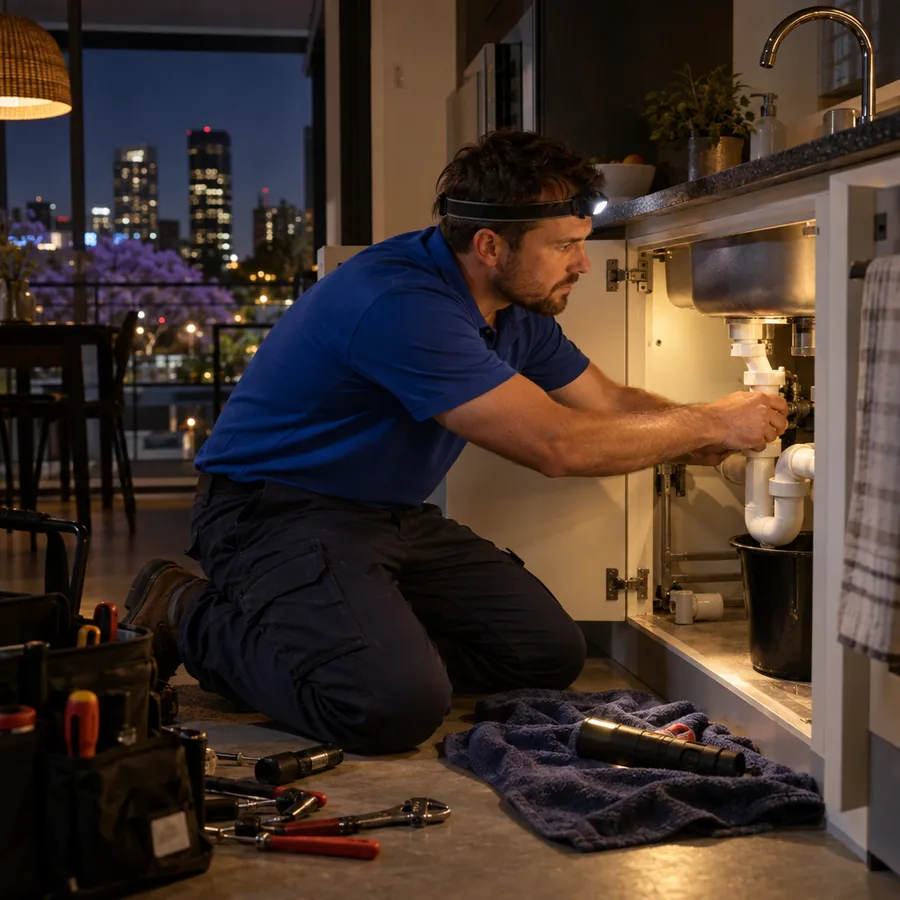
Braided flexible hoses under kitchen sinks, vanities and toilets are behind a large share of apartment floods in the towers around Parramatta Square and Church Street, the Westmead health precinct, Wentworthville, Merrylands, Liverpool CBD and Bankstown. The stainless braid corrodes, often from bleach and cleaning products stored in the cupboard beneath it, the rubber liner splits, and the hose lets go at full mains pressure while the resident is at work. The water runs into the unit below before anyone notices. Flexi hoses have a limited service life, and the repair replaces the failed hose with one rated for the building’s pressure and an isolation valve within reach. In a strata building the failed hose and the photos of it matter, because the question of who pays for the ceiling downstairs turns on what failed and why.
High mains pressure near Prospect Reservoir
Western Sydney is fed largely from Prospect Reservoir and the Warragamba supply. Low-lying suburbs near Prospect, including Wetherill Park, Smithfield, Fairfield and Guildford, and streets down along the Parramatta River, can run mains pressure well above what fixtures are designed for. High pressure hammers old copper, bursts flexi hoses, and blows relief valves on hot water units. The tell-tale signs are pipes banging when a tap closes and a shower that stings. A pressure limiting valve fitted at the meter brings it down to a safe level, and after a second or third burst in the same property it is the first thing to check. New estates in Schofields, Marsden Park, Austral and Oran Park usually have one fitted from the start; older homes often do not.
Heat on sun-exposed PVC and clay movement on the Cumberland Plain
Penrith is regularly the hottest place in the Sydney basin, and a run of days over forty is hard on any pipe that sees the western sun. PVC on an exposed wall, the cold water line to an outdoor hot water unit or an irrigation line run over concrete all expand and soften, then split at a joint or where a clamp holds them rigid. The repair uses a material and fixings that allow for movement, and shades or insulates the run.
Under the ground, most of Western Sydney sits on the Cumberland Plain, reactive clay derived from Wianamatta shale that swells in a wet summer storm season and shrinks in drought. That movement pulls on rigid pipes at their joints, which is why old water services and earthenware sewers across Blacktown, Mount Druitt, Liverpool, Fairfield, Penrith and Campbelltown crack underground. A burst water service between the meter and the house on a clay block is usually found by pressure testing and moisture readings before anything is dug, and replaced in a material that can flex.
Sydney Water, NSW Fair Trading and who fixes what
Sydney Water owns the water main in the street, the service up to and including the meter, and the meter itself. A leak at the meter or bubbling up through the footpath is theirs to fix. Everything on the house side of the meter, the internal plumbing and the private sewer line up to the point of connection with the main, belongs to the property owner and must be repaired by a plumber licensed with NSW Fair Trading under the Home Building Act 1989. You are entitled to ask for the licence number and to check it on the NSW Fair Trading public register online. The repair is quoted before work starts, the failed section is photographed for your insurer or strata manager, and if the fault turns out to be on the Sydney Water side you are told so rather than quoted for it. For a burst at night or on a weekend, the 24 hour plumber page explains how the after-hours rate is handled.
What is included
- Water isolated at the Sydney Water meter or the unit's isolation valve, and the leak located
- Pinhole corrosion in 1960s to 80s copper cut out and replaced, with advice on how much of the run is affected
- Corroded galvanised water lines in Federation and bungalow homes replaced in sections or rerun in copper or PEX
- Failed flexi hoses under sinks, vanities and toilets replaced with hoses rated for the pressure
- Pressure limiting valve fitted where mains pressure is high enough to keep bursting fittings
- Split PVC on sun-exposed walls, garden lines and hot water outlets replaced with the right material
- Repair quoted before work starts, with photos of the failed section for your insurer or strata
Signs you should call now
- Water is spraying or running from a pipe, wall, ceiling or under a bench and will not stop
- The Sydney Water meter is turning with every tap in the house closed
- A damp patch, bubbling paint or a sagging plasterboard ceiling has appeared and is growing
- The water bill has jumped without any change in how the household uses water
- Water pressure has dropped suddenly at every tap
- A hissing sound behind a wall or under the floor when no water is being used
- A puddle under the kitchen sink, vanity or toilet, or water coming through the ceiling of the unit below
Water and electricity do not mix
If water is running near the switchboard, a power point, a light fitting or an appliance, turn the power off at the main switch before you go near it, and do not stand in water to do so. If the ceiling is sagging with water, keep everyone out from under it. It can come down without warning.
Frequently asked questions
Where is the water meter and how do I turn it off?
In most Western Sydney houses the Sydney Water meter sits in a box or on a short stand near the front boundary, often beside the driveway. The stop tap is on the house side of the meter and closes clockwise. In a unit block the meter is usually in a bank near the entrance or in the basement, and each unit should have an isolation valve in the riser cupboard on the landing or under the sink. After closing it, open the lowest tap in the home to drain the pressure. Sydney Water owns the meter itself, so do not force a stiff or seized stop tap.
Why do copper pipes get pinhole leaks in Western Sydney?
Sydney's water chemistry is known for pitting copper from the inside, and it shows up most in homes plumbed between the 1960s and the 1980s in suburbs such as Guildford, Merrylands, Toongabbie, Seven Hills, Kingswood and Revesby. The pit works through the wall over years and opens as a pinhole spray or a slow weep that stains a ceiling or floods under a slab. One pinhole usually means the rest of that run is similarly thin. The repair replaces the failed section, and if the pipe is pitted along its length you are shown that and quoted for rerunning it rather than patching it every few months.
My house is Federation era. What is different about the pipes?
Federation homes and Californian bungalows in North Parramatta, Harris Park and around Parramatta Park, and 1920s homes in Granville and Auburn, were plumbed in galvanised steel. After a century the inside of the pipe rusts and narrows, which is why the pressure at the kitchen tap is poor, and it eventually splits at a thread or a bend. A burst in galvanised pipe is rarely a one-off. The usual fix is to replace the affected run in copper or PEX and plan the rest, and where a later extension has joined copper to galvanised without a dielectric fitting, that joint is a common failure point.
Why do flexi hoses burst and can I prevent it?
Braided flexible hoses under kitchen sinks, vanities and toilets are behind a large share of apartment floods in Parramatta, Westmead, Wentworthville, Liverpool and Bankstown towers. The stainless braid corrodes, often from cleaning chemicals stored under the sink, the rubber inside splits, and the hose lets go at mains pressure, running water into the unit below until someone notices. They have a limited service life and should be inspected and replaced before they fail, with a hose rated for the pressure and a shut-off valve you can reach. High mains pressure without a pressure limiting valve shortens their life further.
Does high water pressure cause bursts?
It does. Western Sydney is fed largely from Prospect Reservoir and the Warragamba supply, and low-lying suburbs near Prospect such as Wetherill Park, Smithfield, Fairfield and Guildford, and streets along the Parramatta River, can have mains pressure high enough to hammer fittings and burst flexi hoses and old copper. If pressure at the tap is very strong, or you hear pipes bang when a tap closes, a pressure limiting valve at the meter brings it down to what fixtures are designed for. New estates in Schofields, Marsden Park and Oran Park usually have one fitted; older homes often do not.
Can heat burst a pipe in summer?
Yes, and in Western Sydney this is a far more common cause than cold. Penrith is regularly the hottest place in the Sydney basin, and PVC on a sun-exposed western wall, an exposed hot water outlet or a garden line run over concrete expands and softens in a run of days over forty, then splits at a joint or where it is clamped. The repair uses a material and fixing that allows for movement and shades or insulates the run. The same heat, followed by a summer storm, drives the wet and dry cycle in Cumberland Plain clay that cracks underground pipes at the joints.
Whose responsibility is the leak, mine or Sydney Water's?
Sydney Water owns the water main in the street, the service up to and including the meter, and the meter itself. Everything on the house side of the meter, the internal plumbing and the private sewer line up to the point of connection with the main, belongs to the property owner. A leak at the meter or in the footpath is reported to Sydney Water; a leak between the meter and the house is yours, repaired by a plumber licensed with NSW Fair Trading. If the plumber finds the fault is on the Sydney Water side, you are told so rather than quoted for it.